SEO vs SEM in Digital Marketing: Key Differences, Examples & Tools
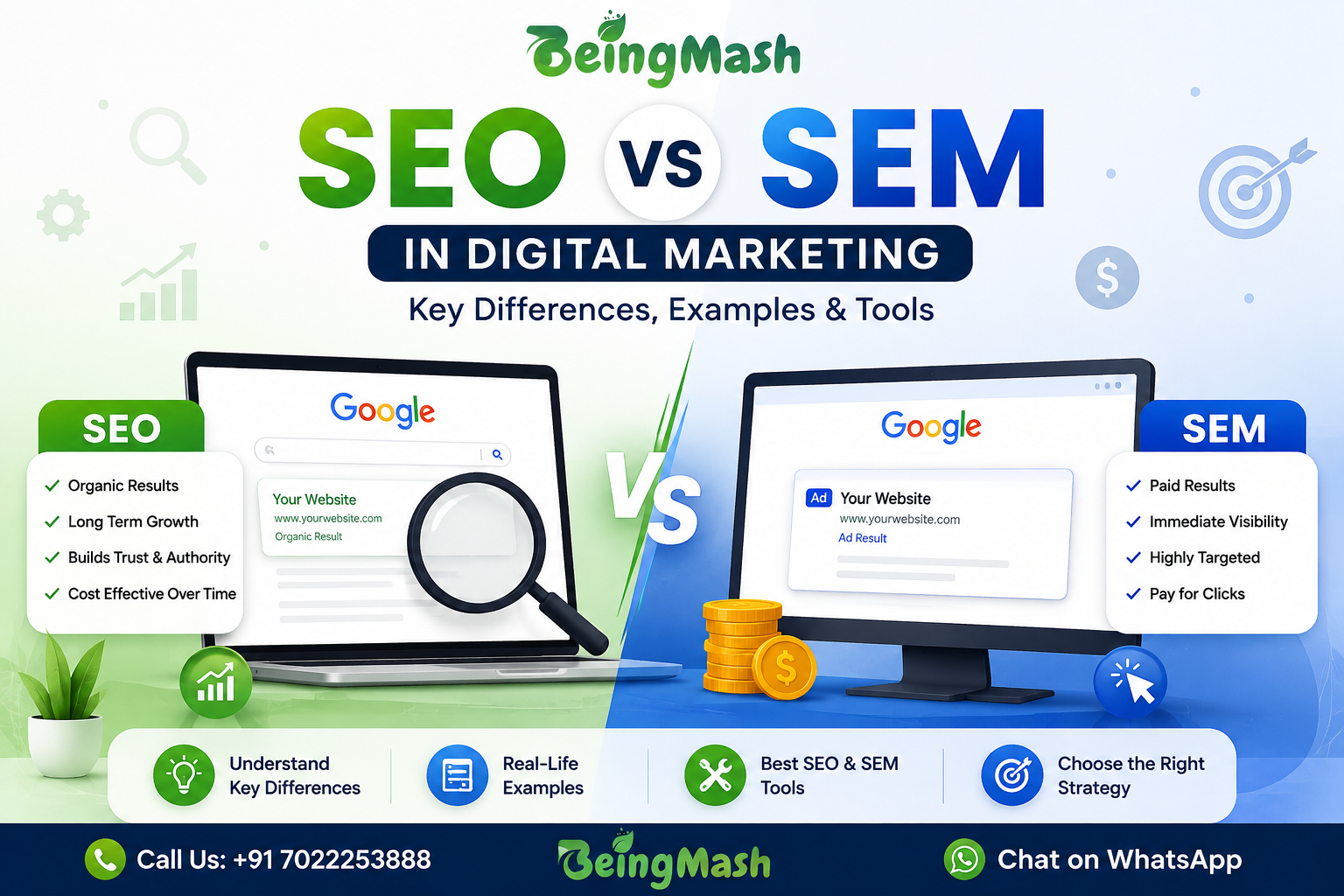
SEO vs SEM in digital marketing is an important topic for business owners, marketers, students, and anyone who wants to understand how search engines can help businesses grow online. Although both strategies focus on reaching potential customers through search engines, they work in different ways.
SEO, or Search Engine Optimization, focuses on improving a website’s organic visibility in search results. On the other hand, SEM, or Search Engine Marketing, is commonly associated with paid search advertising. Understanding these differences can help you choose the right strategy based on your goals, budget, audience, and timeline.
In this guide, we will explain SEO and SEM in simple language. You will learn their full forms, key differences, real-world examples, costs, useful tools, benefits, and how businesses can use both strategies together.
What Is SEO in Digital Marketing?
SEO stands for Search Engine Optimization.
It is the process of improving a website so that search engines can better understand its content and users can discover it through organic search results.
For example, suppose you own a digital marketing company. A potential customer searches Google for:
“digital marketing agency near me”
If your website has useful content, relevant service pages, good technical SEO, and a strong search presence, it may appear in the organic search results.
Some important SEO activities include:
- Keyword research
- On-page SEO
- Technical SEO
- Content optimization
- Internal linking
- Image optimization
- Local SEO
- Website speed optimization
- Off-page SEO
- Backlink development
In addition, SEO is generally considered a long-term digital marketing strategy. Building organic visibility can take time, especially when your website is competing with established websites. BeingMash SEO Services.
What Is SEM in Digital Marketing?
SEM stands for Search Engine Marketing.
In digital marketing, the term SEM is commonly used when talking about paid search advertising, including advertisements displayed through platforms such as Google Ads.
For example, imagine a company that offers website development services. The business can create a paid search campaign to reach people who are actively looking for website development.
When someone searches for a relevant term, an advertisement may appear based on factors such as campaign settings, competition, bidding, relevance, and other advertising factors.
As a result, paid search can help businesses reach potential customers without waiting for organic search rankings to develop.
For beginners, the basic idea is simple:
- SEO focuses mainly on organic search visibility.
- SEM commonly involves paid search advertising.
- SEO can support long-term organic growth.
- SEM can provide faster paid visibility.
You can learn more about Search campaigns from Google Ads Search Campaigns.
SEO SEM Full Form
If you are new to digital marketing, you may first want to know the SEO SEM full form. Understanding these terms makes it easier to understand the difference between SEO and SEM.
Here is the simple explanation:
SEO: Search Engine Optimization
SEM: Search Engine Marketing
Both strategies are connected to search engines, but they use different methods to reach potential customers.
In simple terms:
SEO → Organic search visibility
SEM → Paid search marketing
For example, SEO helps a website work toward appearing in organic search results. On the other hand, SEM commonly involves paid search advertisements that can appear when people search for relevant products or services.
SEO vs SEM in Digital Marketing: What Is the Difference?
The main difference in SEO vs SEM in digital marketing is how a business obtains visibility in search results.
| Factor | SEO | SEM |
|---|---|---|
| Full form | Search Engine Optimization | Search Engine Marketing |
| Main approach | Organic visibility | Paid search marketing |
| Traffic | Organic | Paid |
| Cost model | Investment in SEO activities | Advertising budget |
| Speed | Usually takes time | Can provide faster visibility |
| Long-term potential | Strong | Depends on continued campaigns |
| Main activities | Content, technical SEO, optimization | Ads, keywords, bidding, targeting |
| Best for | Long-term organic growth | Faster targeted visibility |
The easiest way to understand SEO vs SEM is to look at how each strategy helps your website reach potential customers.
With SEO, you work to improve your website’s organic visibility. As a result, people can discover your pages through unpaid search results when your content is relevant to their search.
In contrast, paid search marketing allows businesses to advertise for relevant searches. These advertisements can provide faster visibility, depending on the campaign, competition, budget, and targeting.
For example, a company can use SEO to build long-term organic traffic while using SEM to reach potential customers through paid search campaigns.
Therefore, SEO and SEM can work together as part of a complete digital marketing strategy.
Difference Between SEO and SEM With Examples
The difference between SEO and SEM with examples becomes easier to understand when we look at how a business can use both strategies in a real situation.
SEO Example
For example, imagine a digital marketing company creates an article about “How to Generate Leads From Website.”
The company optimizes the article for relevant search terms, improves the page structure, adds useful internal links, and provides helpful information to readers.
Over time, the article may appear in organic search results if search engines consider the content relevant and useful for users.
The business does not pay Google for every organic click. Instead, it invests in creating and optimizing content that can attract organic visitors.
SEM Example
On the other hand, imagine the same company wants faster visibility for its digital marketing services.
The business can create a Google Search campaign and target relevant commercial keywords. When potential customers search for those terms, the company’s advertisement may be eligible to appear in the search results.
Unlike organic SEO traffic, paid search advertising requires an advertising budget. The actual cost can depend on factors such as competition, bidding, targeting, and campaign performance.
SEO vs SEM Example in Simple Terms
The difference can be remembered easily:
SEO example → A useful website page appears in organic search results.
SEM example → A business pays for a search advertisement that can appear for relevant searches.
In short, SEO focuses on building organic search visibility, while SEM commonly involves paid search advertising. Therefore, businesses can use either strategy or combine both depending on their goals, budget, and marketing needs.
SEO vs SEM Marketing: Which Is Faster?
When people compare SEO vs SEM marketing, one of the first questions they ask is which strategy can produce results faster.
Generally, SEM can provide search visibility soon after a paid search campaign is approved and starts serving. This makes it useful for businesses that want to reach potential customers quickly.
In contrast, SEO usually takes more time because organic visibility depends on factors such as content quality, competition, website authority, relevance, and technical performance.
However, taking more time does not mean that SEO is less valuable. Instead, SEO can support long-term organic growth and help a website build a stronger search presence.
SEO Is Generally Better Suited for:
- Long-term organic growth
- Content visibility
- Building search presence
- Informational searches
- Sustainable website growth
SEM Can Be Useful for:
- Faster search visibility
- Promotional campaigns
- High-intent searches
- Lead generation
- Testing commercial keywords
Ultimately, businesses do not always have to choose between SEO and SEM. For example, a company can use SEM to generate targeted traffic in the short term while continuing to invest in SEO for long-term organic growth.
Therefore, using both strategies together can create a balanced search marketing approach.
SEO and SEM in Digital Marketing Strategy
A good SEO and SEM in digital marketing strategy can combine organic search visibility with paid search advertising. By using both approaches, businesses can reach potential customers at different stages of their buying journey.
For example, a business can use:
- SEO to build organic search traffic.
- SEM to reach potential customers through paid search.
- Content marketing to answer customer questions and build trust.
- Landing pages to encourage visitors to make an enquiry.
- Analytics to measure traffic, leads, and conversions.
Together, these activities can create a complete customer journey.
For example:
Search → Website → Useful Information → Trust → Enquiry → Customer
However, getting more website visitors should not be the only goal. A successful strategy should focus on attracting relevant visitors who are genuinely interested in the products or services you offer.
As a result, businesses should focus on both attracting the right audience and giving visitors a clear reason to take the next step.
SEO vs SEM vs SMM
Another popular comparison in digital marketing is SEO vs SEM vs SMM. Understanding the difference between these three strategies can help businesses choose the right way to reach their target audience.
SMM stands for Social Media Marketing. Unlike SEO and SEM, which focus mainly on search engines, SMM uses social media platforms to reach and engage potential customers.
Although all three are important digital marketing strategies, each one works differently.
SEO
SEO focuses on improving organic visibility through search engines.
For example, a person searches Google for a service and discovers your website through an organic search result. The business does not pay for that individual organic click.
SEM
SEM commonly involves paid search marketing.
For example, someone searches for a particular service and sees a relevant paid advertisement. The business uses an advertising budget to reach people through search.
SMM
SMM focuses on marketing through social media platforms.
For example, a potential customer may discover a business through an Instagram, Facebook, LinkedIn, or other social media post or advertisement.
Simple Comparison of SEO, SEM and SMM
The easiest way to remember the difference is:
SEO = Organic search visibility
SEM = Paid search marketing
SMM = Social media marketing
In short, SEO helps businesses build organic search visibility, SEM can provide targeted paid search visibility, and SMM helps businesses reach audiences through social media.
Therefore, a business can use all three strategies depending on its target audience, marketing goals, available budget, and customer journey.
SEO and SEM Tools
Understanding SEO and SEM tools is important for anyone learning digital marketing. These tools help marketers research keywords, understand website performance, manage campaigns, and make better decisions based on data.
SEO Tools
SEO professionals use different tools to understand how websites perform in organic search and where improvements may be needed.
Common SEO activities include:
- Keyword research
- Website audits
- Search performance analysis
- Ranking analysis
- Backlink research
- Competitor research
- Technical SEO checks
- Content optimization
For example, Google Search Console can help website owners understand how their pages perform in Google Search. It can provide useful information about search queries, impressions, clicks, and indexing.
You can learn more from the official Google Search Central SEO documentation.
SEM Tools
SEM professionals use advertising platforms and supporting tools to manage paid search campaigns.
These activities can include:
- Keyword targeting
- Search advertising
- Campaign management
- Budget management
- Bid management
- Conversion tracking
- Ad performance analysis
- Search-term analysis
For example, Google Ads allows advertisers to create and manage Search campaigns based on their marketing objectives.
In addition, conversion tracking can help businesses understand whether their advertising traffic is leading to enquiries, purchases, or other valuable actions.
SEO vs SEM Cost: Which Is More Expensive?
Cost is another important consideration when comparing SEO vs SEM.
Many beginners assume:
SEO = Free
SEM = Paid
However, this is not a complete picture.
SEO Costs
Organic search results do not require businesses to pay Google for every organic click. However, building and maintaining SEO can still require an investment.
Businesses may spend money on:
- Content creation
- SEO professionals
- Website development
- Technical optimization
- SEO software
- Website maintenance
- Digital PR and link-building activities
As a result, SEO should be viewed as an investment in organic search visibility rather than simply a free marketing channel.
SEM Costs
Paid search advertising requires an advertising budget.
Depending on the campaign, businesses may need to invest in:
- Search advertisements
- Campaign management
- Landing pages
- Keyword targeting
- Conversion tracking
- Campaign optimization
For example, a business may set a daily advertising budget and optimize its campaign based on clicks, conversions, and other performance data.
Therefore, instead of asking only “Which one is cheaper?”, businesses should consider:
“Which strategy can provide the best return for our business objective?”
The answer can be different for every business.
SEO vs SEM for Small Businesses
Small businesses often have limited marketing budgets. Therefore, choosing between SEO and SEM requires careful consideration of business goals and expected results.
SEO May Be Suitable When:
- You want to build long-term organic traffic.
- Your customers regularly use search engines.
- You want to create useful content.
- You want to increase organic visibility.
- You are prepared to invest time in growth.
SEM May Be Suitable When:
- You need faster search visibility.
- You have an advertising budget.
- You want to target specific searches.
- You are promoting a particular product or service.
- You want to test market demand.
Using SEO and SEM Together
A small business does not always have to choose just one strategy.
For example, a company can use SEM to generate targeted paid traffic while continuing to invest in SEO for long-term organic visibility.
The process could look like this:
SEM → Generate targeted paid traffic
SEO → Build organic visibility
Website → Convert visitors into leads
Follow-up → Convert leads into customers
In this way, SEO and SEM can support different stages of the same marketing journey.
Ultimately, the best choice depends on the company’s goals, budget, competition, target audience, and timeline.
SEO and SEM in Digital Marketing Course: What Should Beginners Learn?
People searching for an SEO and SEM in digital marketing course should first learn the fundamentals before moving on to advanced strategies. A step-by-step approach makes these concepts much easier to understand and apply.
Start With Digital Marketing Fundamentals
Before learning SEO and SEM, it helps to understand how digital marketing works.
Start by learning:
- Search engines
- Keywords
- Search intent
- Websites
- Digital advertising
- Conversion tracking
Once these basics are clear, you can move on to SEO and SEM.
Learn SEO
The next step is to understand how websites can improve their organic search visibility.
Important SEO topics include:
- Keyword research
- On-page SEO
- Technical SEO
- Content SEO
- Internal linking
- Local SEO
- Off-page SEO
For example, you can learn how to optimize a service page, create useful content, and structure a website so that both users and search engines can understand it easily.
Learn SEM
After understanding SEO, you can explore paid search marketing.
Important SEM topics include:
- Google Ads
- Search campaigns
- Keyword targeting
- Ad copy
- Bidding
- Budget management
- Conversion tracking
In addition, learning how to measure campaign performance is essential because successful paid advertising is not only about getting clicks. It is also about generating useful results.
Finally, Practice What You Learn
Reading about SEO and SEM is helpful, but practical experience makes the concepts much easier to understand.
For example, you can create a test website, optimize one page for SEO, and set up a sample paid search campaign.
As you practice, you will start to understand how keywords, search intent, website pages, advertisements, and conversions work together.
SEO and SEM Courses: What Skills Should You Look For?
When choosing SEO and SEM courses, don’t focus only on the course title. Look for practical training that teaches you how to apply the concepts to real marketing situations.
A useful course should cover areas such as:
- Keyword research
- Website optimization
- Content strategy
- Technical SEO
- Google Search Console
- Google Ads
- Search campaigns
- Conversion tracking
- Analytics
- Campaign optimization
Moreover, practical assignments can help beginners understand how search marketing works outside the classroom.
Before choosing a course, check whether it includes hands-on projects, real campaign examples, and opportunities to practice the skills being taught.
How SEO and SEM Work Together
SEO and SEM do not have to compete with each other. Instead, they can support different parts of the same digital marketing strategy.
For example, imagine a business is launching a new service. The company can follow these steps:
- Create a useful service page.
- Optimize the page for relevant search terms.
- Publish supporting SEO content.
- Launch a targeted paid search campaign.
- Track website visits and enquiries.
- Improve the landing page based on performance.
- Continue building organic visibility.
As a result, the business can work toward short-term opportunities through paid search while continuing to develop long-term organic visibility through SEO.
The two strategies can therefore work together rather than being treated as completely separate marketing channels.
SEO vs SEM for Lead Generation
Both SEO and SEM can contribute to lead generation.
SEO can attract people who are researching a problem, comparing solutions, or looking for a service.
SEM can help businesses reach people who are actively searching for specific products or services.
But getting visitors is only the first step.
Your website also needs:
- Clear service information
- Strong calls to action
- Easy contact options
- Mobile-friendly design
- Fast loading pages
- Trust signals
- Testimonials
- Simple forms
- WhatsApp contact
- Phone contact
If you want to learn more about turning website visitors into enquiries, read our guide on How to Generate Leads From Website.
How Internal Links Help Your SEO Strategy
Internal Links for SEO and SEM
Internal links connect one page on your website to another relevant page. They help visitors discover related information and can also help search engines understand the structure and relationship between pages.
For example, this article can naturally connect to other useful BeingMash pages, such as:
- SEO services
- Digital marketing services
- Website development services
- Website lead generation
Instead of adding links randomly, place them where they are genuinely useful to the reader.
For example:
Businesses looking to improve their organic search visibility can explore our SEO services.
Link SEO services to your BeingMash SEO service page.
Later in the article, you can write:
A well-designed website is also important when converting search traffic into enquiries. Businesses can explore our website development services to improve their online presence.
Link website development services to your BeingMash website development page.
You can also connect this article with your existing article about how to generate leads from website. This gives readers an easy way to learn how search traffic can be converted into actual business enquiries.
External Links for SEO and SEM
External links can make an article more useful when they direct readers to reliable and relevant sources.
For this article, official Google resources are particularly useful because they provide additional information about SEO and paid search advertising.
You can use these authoritative resources:
- Google Search Central SEO documentation
- Google Ads Search campaign documentation
- Google Search Central link best practices
In addition, these resources allow readers to explore official information beyond the explanations provided in this article.
Which Is Better: SEO or SEM?
There is no universal answer to SEO vs SEM. The better choice depends on your business goals, budget, competition, audience, and expected timeline.
Choose SEO When You Want:
- Long-term organic visibility
- Sustainable content growth
- More organic traffic
- A stronger search presence
- Long-term investment in your website
Choose SEM When You Want:
- Faster paid visibility
- Targeted search traffic
- Promotional campaigns
- High-intent traffic
- Measurable advertising campaigns
Choose Both When:
You want to build organic visibility while also reaching potential customers through paid search.
For example, a business can use SEM to reach potential customers in the short term while continuing to invest in SEO for long-term organic growth.
As a result, combining both strategies can provide a balanced approach to search marketing.
SEO vs SEM in Digital Marketing: Final Verdict
The easiest way to understand SEO vs SEM in digital marketing is to remember that they use different approaches to reach people through search.
SEO focuses on improving organic search visibility.
SEM commonly focuses on paid search marketing.
SEO can be valuable for long-term growth, while SEM can help businesses gain targeted visibility through paid search campaigns.
The right strategy depends on your:
- Business goals
- Budget
- Competition
- Target audience
- Customer journey
- Marketing timeline
- Products or services
Instead of asking which strategy is universally better, businesses should consider which approach best matches their specific objectives.
Ultimately, a strong digital marketing strategy can combine SEO, SEM, content marketing, social media, website optimization, and conversion strategies to reach the right audience and generate meaningful business results.
Frequently Asked Questions About SEO vs SEM
What Is the SEO SEM Full Form?
SEO stands for Search Engine Optimization.
SEM stands for Search Engine Marketing.
SEO focuses on organic search visibility, while SEM is commonly associated with paid search marketing.
What Is the Difference Between SEO and SEM?
SEO focuses on improving organic search visibility, while SEM commonly involves paid search marketing.
The main difference is how businesses gain visibility in search results.
What Are Some SEO vs SEM Examples?
An SEO example is optimizing a website page so that it can appear in organic search results.
An SEM example is running a paid search advertising campaign for relevant keywords.
Is SEO Better Than SEM?
Neither strategy is automatically better.
SEO can support long-term organic growth, while SEM can provide faster paid search visibility.
The right choice depends on your business goals, budget, audience, and timeline.
Can SEO and SEM Be Used Together?
Yes. Businesses can use SEO to build organic visibility while using SEM to generate targeted paid traffic.
Together, they can support different parts of the customer journey.
What Are SEO and SEM Tools?
SEO tools can help with keyword research, technical SEO, rankings, backlinks, website audits, and search performance.
SEM tools can help with keyword targeting, advertising campaigns, bidding, budgets, conversion tracking, and campaign performance.
Is SEM the Same as Google Ads?
No.
Google Ads is an advertising platform that supports paid search campaigns. SEM is a broader term used in search marketing.
How Long Does SEO Take?
There is no guaranteed timeline for SEO.
Results can vary depending on factors such as competition, website quality, content, technical SEO, authority, and the search market.
Ready to Improve Your Digital Marketing Strategy?
SEO and SEM can both play an important role in helping businesses reach potential customers online.
If you need help with SEO, digital marketing, website development, or lead generation, the BeingMash team can help you choose a strategy based on your business goals.
Explore BeingMash Digital Marketing Services
📞 Call BeingMash
+91 7022253888